
An AI acceptable use policy tells staff which AI tools they may use, what they may put into them and how they must check what comes out. The OAIC’s guidance on commercially available AI products is not a policy template, but it gives a firm basis for what to include.
Start from the Privacy Act, not the tool
The OAIC says the Privacy Act and the Australian Privacy Principles apply to all uses of AI involving personal information. Obligations apply to personal information entered into an AI system and to AI output that contains personal information. The OAIC includes inferred, incorrect or artificially generated information about an identifiable person, such as hallucinations and deepfakes. Its guidance was published on 21 October 2024 and updated on 17 January 2025.
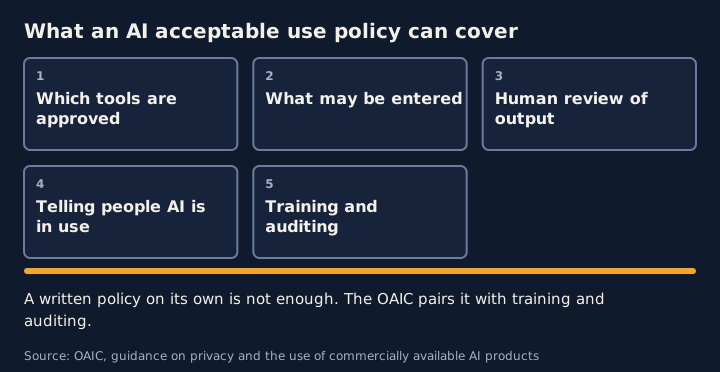
Which tools are approved
The OAIC says organisations should not adopt an AI product simply because it is available. It expects due diligence on whether the product suits the intended use, how human oversight is embedded, the privacy and security risks, and who can access the information put in. It also says that due diligence should not be “set and forget”, with regular review, staff training and monitoring across the product’s life.
A policy can therefore name approved tools, name who approves new ones, and require a privacy impact assessment, which the OAIC recommends.
What may be entered
The OAIC recommends, as best practice, that organisations do not enter personal information, and particularly sensitive information, into publicly available generative AI tools. Its example is staff at an insurer entering a customer’s claim details, including health information, into a public chatbot. It says that is a disclosure to the chatbot’s owner that must be justified under APP 6.
It also warns that some products let the owner collect inputs for further training, and that some tools pass prompts to a third party such as a search engine. A policy should say that staff check these settings. The OAIC adds that any prohibition on entering personal information needs robust training and auditing to back it up.
Checking the output
The OAIC notes AI systems can produce inaccurate or false results, especially generative AI. APP 10 requires reasonable steps to keep personal information accurate. A policy can require human review before AI output is used in a decision about a person, and the OAIC treats AI used in decisions with a legal or similarly significant effect as likely high privacy risk.
Telling people AI is in use
The OAIC says organisations should update privacy policies and notifications with clear information about their use of AI, and identify public-facing AI tools such as chatbots as AI.
What the National AI Centre adds
The OAIC guidance is about privacy. For the wider policy, the National AI Centre published “Guidance for AI adoption: foundations” on 5 May 2026, for organisations that are starting to use AI or use it in low-risk ways. It sets out six essential practices: decide who is accountable, understand impacts and plan accordingly, measure and manage risks, share essential information, test and monitor, and maintain human control. Four of its “getting started” actions translate straight into policy clauses:
- Assign a senior leader as the overall AI governance owner, and create an AI policy that gives staff advice on AI risks and how to manage them.
- Create and maintain an AI register that documents your AI systems and how you use them, including AI embedded in other systems.
- Disclose your use of AI, especially where it influences decisions, generates content that can meaningfully affect people, or can be mistaken for a human.
- Ensure meaningful human oversight that matches the system’s autonomy and the stakes, with clear points where a human can pause, override, roll back or shut it down.
The guidance also says the same tool can carry different risks depending on how it is used, and that some practices apply organisation-wide, such as having an AI policy, while others apply to individual uses. A policy can reflect that by listing approved tools and, separately, which uses need extra approval.
Making the policy work
The OAIC says controls on what goes into AI inputs need to be accompanied by training and auditing. A written policy on its own is not enough.
To see how ready your organisation is, see the AI Readiness and Oversharing Assessment.
Frequently asked questions
What is an AI acceptable use policy?
It is an internal policy that says which AI tools staff may use, what information they may put into them and what checks apply to the results. The OAIC recommends organisations establish policies and procedures for the use of AI systems.
Can staff enter personal information into ChatGPT or similar tools?
The OAIC recommends, as best practice, that organisations do not enter personal information, and particularly sensitive information, into publicly available generative AI tools.
Does the Privacy Act apply to AI tools?
The OAIC says the Privacy Act applies to all uses of AI that involve personal information, including the information entered and any personal information the tool generates.
Sources
- Guidance for AI adoption: foundations (National AI Centre)
- Guidance on privacy and the use of commercially available AI products (Office of the Australian Information Commissioner)
General guidance for security and privacy teams. For advice on your legal obligations, speak to a lawyer.