
Under the Notifiable Data Breaches (NDB) scheme, an organisation the Privacy Act 1988 covers must notify affected individuals and the OAIC when a data breach is likely to result in serious harm to someone whose personal information is involved.
What counts as an eligible data breach
The OAIC sets three conditions. There is unauthorised access to or disclosure of personal information the organisation holds, or a loss of it. The breach is likely to result in serious harm to one or more individuals. And the organisation has not been able to prevent that likely harm with remedial action.
The OAIC’s examples include a lost or stolen device holding customer information, a hacked database, and personal information mistakenly given to the wrong person. It also lists an employee browsing sensitive customer records without any legitimate purpose.
Who the scheme covers
The OAIC’s quick reference guide says entities with existing obligations to secure personal information under APP 11 must comply. It lists Australian Government agencies, businesses and not-for-profits with annual turnover above $3 million, private sector health service providers, credit reporting bodies and credit providers, and some small business operators. If you are unsure whether you are covered, confirm it with your legal adviser.
What to do when a breach is suspected
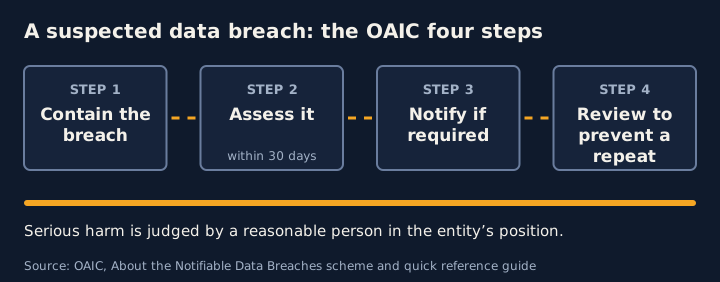
The OAIC describes four steps: contain the breach, assess it, notify if required, and review the incident to prevent a repeat. On assessment, it says an entity must take all reasonable steps to finish within 30 calendar days after it becomes aware of the grounds for suspicion. Where notification is required, it must happen as soon as practicable.
Serious harm is judged by a reasonable person in the entity’s position. The OAIC says it can include physical, psychological, emotional, financial or reputational harm, and that it is “likely” when it is more probable than not rather than merely possible.
What a notification must say
Notifications to the OAIC and to individuals must include the organisation’s name and contact details, a description of the breach, the kinds of information involved, and recommended steps for individuals. The OAIC asks for plain English and no technical jargon. Notify the OAIC using its online form, and attach a copy of the template notification to individuals.
Exceptions and shared data
The OAIC lists exceptions for enforcement related activities, secrecy provisions and declarations by the OAIC. If several entities jointly hold the information, only one needs to assess and notify, and the OAIC suggests the entity with the most direct relationship with the individuals usually should.
What this means for a security team
The assessment is only as fast as your ability to say what personal information was involved and where it sat. That is a data discovery and classification question as much as an incident one.
If you want to test how ready your data controls are, see the Data Protection Health Check.
Frequently asked questions
What is the Notifiable Data Breaches scheme?
Under the scheme, an organisation or agency covered by the Privacy Act must notify affected individuals and the OAIC when a data breach is likely to result in serious harm to an individual whose personal information is involved.
How long do we have to assess a suspected breach?
The OAIC says an entity must take all reasonable steps to complete the assessment within 30 calendar days after the day it becomes aware of the grounds that caused it to suspect an eligible data breach.
What must a notification include?
The OAIC lists the organisation name and contact details, a description of the data breach, the kinds of information involved, and recommendations about the steps individuals should take.
Sources
- About the Notifiable Data Breaches scheme (Office of the Australian Information Commissioner)
- When to report a data breach (Office of the Australian Information Commissioner)
- Report a data breach (Office of the Australian Information Commissioner)
- Quick reference guide for responding to data breaches (Office of the Australian Information Commissioner)
General guidance for security and privacy teams. For advice on your legal obligations, speak to a lawyer.