
Prudential Standard CPS 234 Information Security applies to APRA-regulated entities and sets out what they must do to stay resilient against information security incidents, including cyber-attacks. APRA’s determination applies it to all ADIs and authorised banking NOHCs, general insurers and authorised insurance NOHCs, life companies, private health insurers and RSE licensees.
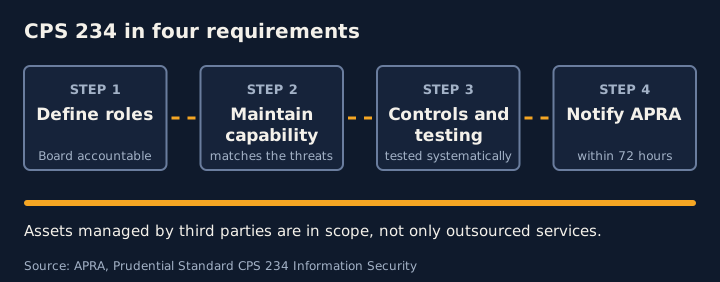
The four core requirements
APRA summarises the standard as requiring an entity to:
- clearly define information security roles and responsibilities for the Board, senior management and others
- maintain an information security capability commensurate with the size and extent of threats to its information assets
- implement controls that match the criticality and sensitivity of those assets, and test them systematically
- notify APRA of material information security incidents
The standard says the Board is ultimately responsible for the entity’s information security.
Classification, controls and third parties
The entity must classify its information assets, including those managed by related parties and third parties, by criticality and sensitivity. Controls must be proportionate to that classification.
Where a related party or third party manages the assets, the entity must assess that party’s information security capability and evaluate the design of its controls. APRA states that this applies to all such assets, not only those under outsourcing agreements covered by other prudential standards.
Testing and incident plans
The standard requires a systematic testing program for control effectiveness, with nature and frequency matched to factors it lists. The sufficiency of that program must be reviewed at least annually or when there is a material change. Control deficiencies that cannot be fixed in a timely way must be escalated to the Board or senior management.
Entities must also keep response plans for incidents that could plausibly occur, covering escalation and reporting to the Board, and must review and test those plans annually.
Notification
An entity must notify APRA as soon as possible and no later than 72 hours after becoming aware of an incident that materially affected, or could materially affect, the entity or its customers, or that has been notified to other regulators. It must also notify APRA within 10 business days of a material control weakness it does not expect to fix in time.
What this means for Microsoft 365 environments
CPS 234 does not name products. For a security team the practical question is whether you can show, for the data held in your tenant, how it is classified, who can reach it and how you test that controls work. The Data Protection Health Check is built to answer that.
Frequently asked questions
Who does CPS 234 apply to?
APRA determined it for all ADIs and authorised banking NOHCs, general insurers and authorised insurance NOHCs, life companies including friendly societies, private health insurers and RSE licensees.
How quickly must an incident be notified to APRA?
The standard says as soon as possible and, in any case, no later than 72 hours after becoming aware of an information security incident that meets its criteria.
Does CPS 234 cover third parties?
Yes. The standard requires an entity to assess the information security capability of related parties and third parties that manage its information assets, and to evaluate the design of their controls.
Sources
- Prudential Standard CPS 234 Information Security (Australian Prudential Regulation Authority)
General guidance for security and privacy teams. For advice on your legal obligations, speak to a lawyer.