
There is no single list that applies to every Australian organisation. Which obligations apply depends on your size, your sector, who your customers are, and whether you work for government. This guide is a rough map to help you ask the right questions, not a legal opinion.
Start with the Privacy Act
The Privacy Act 1988 and its 13 Australian Privacy Principles apply to Australian Government agencies and to private sector organisations with annual turnover above $3 million, plus some others, according to the OAIC. The OAIC says most small businesses are not covered, but some are regardless of turnover. These include health service providers, businesses that trade in personal information, credit reporting bodies and businesses accredited under the Consumer Data Right.
Do not stop at the turnover test. The OAIC’s list shows that what a business does can bring it under the Privacy Act regardless of size, for example providing health services or trading in personal information. So the question is about activities as well as turnover, and it is worth asking it for each part of the organisation and each contract.
Check your sector
Some sectors carry their own security obligations on top of the Privacy Act.
- Banks, insurers, private health insurers and superannuation trustees. APRA’s CPS 234 applies to the entities it names.
- Critical infrastructure. The SOCI Act covers 11 sectors, including communications, financial services, data storage or processing, energy, healthcare and transport, where an organisation owns, operates or has a direct interest in a critical infrastructure asset.
- Health. The OAIC says private sector health service providers are covered by the Privacy Act wherever they operate, and in NSW, Victoria and the ACT they must also follow state or territory health privacy laws.
Ask who your customers are
- Selling to or working for the Commonwealth. The OAIC says a small business that is a Commonwealth contracted service provider must comply with the APPs, and the contract may add privacy requirements. Government customers may also ask for Essential Eight maturity by contract.
- State and territory government. The OAIC says most states and territories have privacy laws that cover their own public sector agencies. Check the contract with any state agency customer for what it asks of you.
What is not a general legal requirement
The Essential Eight is ASD guidance for organisations. The Protective Security Policy Framework (PSPF) Release 2026 requires non-corporate Commonwealth entities to implement it to Maturity Level Two, and says the PSPF is better practice, not mandatory, for other Commonwealth entities. So for most private organisations it is a framework you adopt or a customer requires. That does not make it optional if a contract says otherwise.
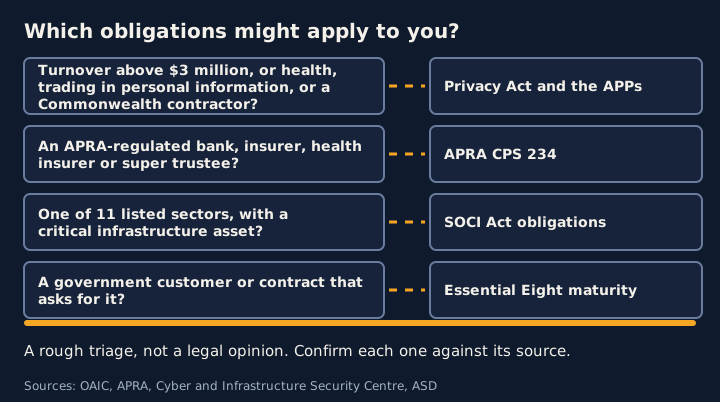
A quick way to triage
- Is your annual turnover above $3 million, or are you a health service provider or a Commonwealth contractor? If yes, assume the Privacy Act applies and confirm it.
- Are you an APRA-regulated entity? If yes, CPS 234 applies.
- Is your sector one of the 11 SOCI sectors, and do you own, operate or hold a direct interest in a critical infrastructure asset? If yes, check the SOCI obligations.
- Do any contracts or customers require Essential Eight maturity or other frameworks?
- Do you hold health records in NSW, Victoria or the ACT? Check the state health privacy law as well.
If you want to test whether your controls would stand up against whichever of these apply, see the Data Protection Health Check.
Frequently asked questions
Does every Australian organisation have to follow the Privacy Act?
No. The OAIC says most small businesses, those with annual turnover of $3 million or less, are not covered, but some are, including health service providers and businesses that trade in personal information.
Is the Essential Eight mandatory for private companies?
Not as a general law. The Protective Security Policy Framework (PSPF) Release 2026 requires non-corporate Commonwealth entities to implement it to Maturity Level Two. Elsewhere it can be required by contract.
Do state privacy laws apply to private companies?
Mostly they cover public sector agencies. The OAIC notes that private sector health service providers in NSW, Victoria and the ACT must comply with both the Privacy Act and state or territory health privacy laws.
Sources
- Small business (Office of the Australian Information Commissioner)
- Australian Privacy Principles (Office of the Australian Information Commissioner)
- State and territory privacy legislation (Office of the Australian Information Commissioner)
- Prudential Standard CPS 234 Information Security (Australian Prudential Regulation Authority)
- Security of Critical Infrastructure Act 2018 (SOCI) (Cyber and Infrastructure Security Centre)
- PSPF Annual Release 2026 (Protective Security Policy Framework)
- Essential Eight explained (Australian Signals Directorate)
General guidance for security and privacy teams. For advice on your legal obligations, speak to a lawyer.