
The Essential Eight is a set of eight mitigation strategies from the Australian Signals Directorate (ASD). The Protective Security Policy Framework (PSPF) requires non-corporate Commonwealth entities to implement it. For most other organisations it is guidance you choose to adopt, unless a contract or customer requires it.
What it is
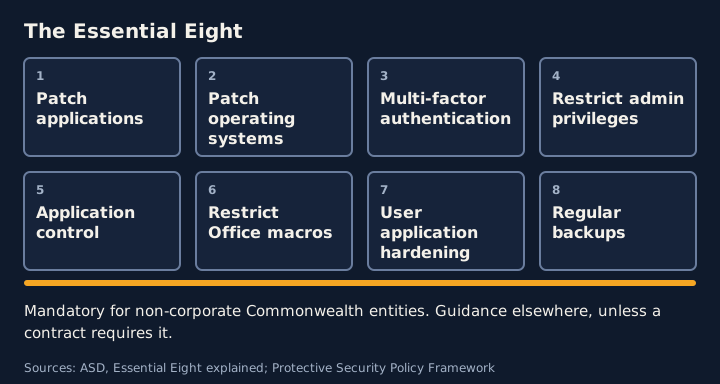
ASD says the Essential Eight is the most effective of its prioritised mitigation strategies for cyber threats, and that its maturity model supports implementation. The eight strategies are patch applications, patch operating systems, multi-factor authentication, restrict administrative privileges, application control, restrict Microsoft Office macros, user application hardening and regular backups.
ASD says it was designed to protect internet-connected information technology networks. Its principles can be applied to enterprise mobility and operational technology, but it was not designed for those and alternative strategies may suit them better.
Where it is mandatory
PSPF Release 2026, issued on 1 July 2026, says entities are required to implement the Essential Eight strategies to Maturity Level Two under ASD’s Essential Eight Maturity Model. It also says all non-corporate Commonwealth entities are required to adhere to the PSPF. For other Commonwealth entities, meaning corporate Commonwealth entities and Commonwealth companies, the PSPF says it represents better practice but is not mandatory. The PSPF also directs service providers that deliver services to Australian Government entities or must implement it under a deed or agreement. ASD’s FAQ describes Maturity Level Two as a mandatory baseline for non-corporate Commonwealth entities subject to the PSPF.
Where it is required by contract
ASD’s FAQ gives the example of an organisation that is contractually required to implement Maturity Level Two. If you supply government, read the contract and any security schedule. It is the contract, not the Essential Eight itself, that creates the obligation.
Where it is a choice
Outside those cases, we found no source that makes it a general legal requirement for private organisations. Many adopt it anyway as a baseline, and ASD provides an assessment process guide for testing implementation.
If no contract requires it, the Essential Eight is a reasonable baseline against common attacks on internet-connected systems, which is the scope ASD gives it. It is not a substitute for knowing where your sensitive data sits, and it should not be presented to a board as if it were.
Not the same as data protection
The strategies are mostly about hardening systems and recovery. They do not on their own tell you where sensitive data sits or who can reach it, which is what the Privacy Act, CPS 234 and Copilot readiness depend on. To test where yours stands, see the Data Protection Health Check.
Frequently asked questions
Is the Essential Eight mandatory?
For non-corporate Commonwealth entities, yes: PSPF Release 2026 requires them to implement it to Maturity Level Two. ASD describes it as a baseline of eight mitigation strategies to help organisations protect themselves, and contracts can require it.
What are the eight strategies?
Patch applications, patch operating systems, multi-factor authentication, restrict administrative privileges, application control, restrict Microsoft Office macros, user application hardening and regular backups.
What is the Essential Eight designed to protect?
ASD says it is designed to protect internet-connected information technology networks, and was not designed for enterprise mobility or operational technology networks.
Sources
- Essential Eight explained (Australian Signals Directorate)
- Essential Eight maturity model FAQ (Australian Signals Directorate)
- PSPF Annual Release 2026 (Protective Security Policy Framework)
- About the PSPF (Protective Security Policy Framework)
General guidance for security and privacy teams. For advice on your legal obligations, speak to a lawyer.