
The OAIC says the Privacy Act 1988 regulates Australian Government agencies and organisations with annual turnover of more than $3 million, and some other organisations. Most small businesses are not covered, but some are.
Who is an APP entity
The Privacy Act includes 13 Australian Privacy Principles (APPs). They apply to the organisations and agencies the Act covers, which the OAIC calls APP entities. A breach of an APP is an interference with the privacy of an individual and can lead to regulatory action and penalties.
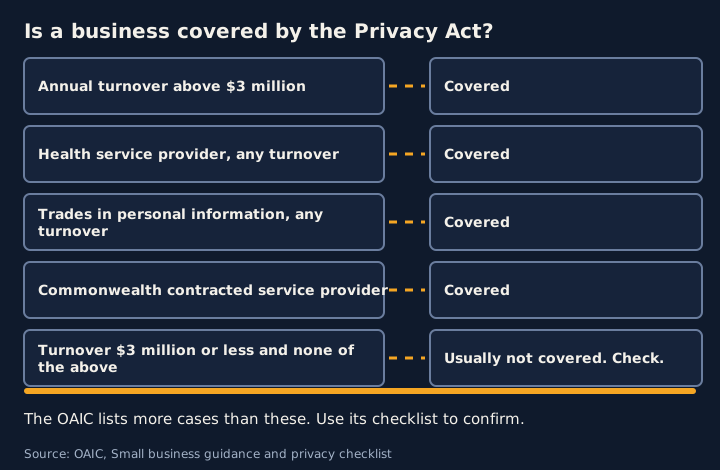
Small businesses that are still covered
The OAIC defines a small business as one with annual turnover of $3 million or less, counting all income from all sources. Regardless of turnover, it says the Act covers any business that:
- is a health service provider
- trades in personal information (the OAIC’s checklist asks about trading without the individual’s consent and without legal requirement or authorisation)
- is a credit reporting body
- holds Consumer Data Right accreditation
Its checklist adds further cases, including a business related to a larger body corporate that is subject to the Act, a Commonwealth contracted service provider, a reporting entity under the AML/CTF Act (for activities under that Act; from 1 July 2026 the OAIC says this brings in “Tranche 2” entities such as lawyers, conveyancers, accountants, real estate professionals and dealers in precious metals and stones), and a business that has chosen to opt in. The OAIC says its checklist is not a substitute for legal advice.
What the security principle asks for
APP 11 is the principle security teams meet first. The OAIC says an APP entity must take steps that are reasonable in the circumstances to protect personal information from misuse, interference and loss, and from unauthorised access, modification or disclosure. It must also take reasonable steps to destroy or de-identify personal information it no longer needs, with exceptions. Reasonable steps include technical and organisational measures, and what is reasonable depends on circumstances such as the entity’s size, resources and complexity.
What this means for a security team
APP 11 is principles-based, so there is no checklist to tick. A practical reading is that you can show what personal information you hold, where it sits, who can reach it and what controls protect it. That is also what a data protection health check tests. See the Data Protection Health Check.
Frequently asked questions
What is the turnover threshold for the Privacy Act?
The OAIC says a small business has annual turnover of $3 million or less, and that annual turnover includes all income from all sources. Most small businesses are not covered, but some are.
Which small businesses are covered regardless of turnover?
The OAIC lists health service providers, businesses that trade in personal information, credit reporting bodies and businesses accredited under the Consumer Data Right, among others.
What does APP 11 require?
The OAIC says an APP entity must take reasonable steps to protect personal information from misuse, interference and loss, and from unauthorised access, modification or disclosure, including technical and organisational measures.
Sources
- Know your privacy obligations under the AML/CTF Act: updated OAIC guidance (Office of the Australian Information Commissioner)
- Small business (Office of the Australian Information Commissioner)
- The Privacy Act (Office of the Australian Information Commissioner)
- Australian Privacy Principles (Office of the Australian Information Commissioner)
- Chapter 11: APP 11 Security of personal information (Office of the Australian Information Commissioner)
General guidance for security and privacy teams. For advice on your legal obligations, speak to a lawyer.