
The Security of Critical Infrastructure Act 2018 (SOCI Act) sets legal obligations for organisations that own, operate or have direct interests in critical infrastructure assets. The Cyber and Infrastructure Security Centre (CISC) says it likely applies to you if your sector is listed and you own, operate or hold a direct interest in such an asset. If your industry is not listed, it says the Act likely does not apply.
The 11 sectors
Communications, financial services and markets, data storage or processing, defence industry, higher education and research, energy, food and grocery, healthcare and medical, space technology, transport, and water and sewerage.
CISC explains that an asset includes premises, computers and data, and that components operating as a single system or network count as one asset. The Act defines each class of asset, so a sector listing alone is not enough to tell you whether a particular asset is covered. CISC publishes asset class definition guidance for that.
Who carries the obligation
Obligations depend on your role and the asset type. CISC says a responsible entity is defined for each asset class in section 12L of the Act. A direct interest holder holds at least 10% of the asset together with associates, or an interest that lets it influence or control the asset. On the page we read, direct interest holders only have the obligation to register. CISC’s financial services page says direct interest holders of financial market infrastructure must also report cyber incidents and keep a risk management program, so check your own sector’s page.
The obligations
CISC lists:
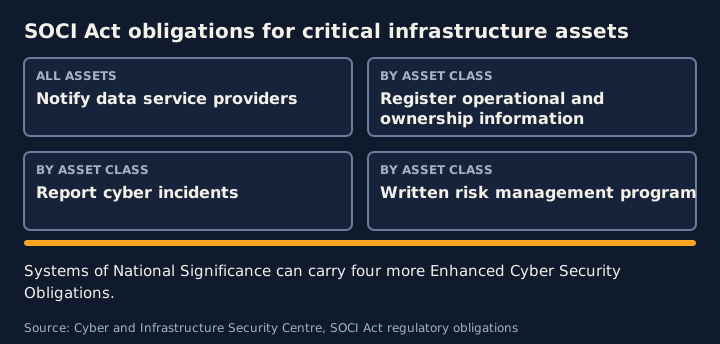
- notifying external data service providers if they store or process business critical data for a critical infrastructure asset (applies to all assets)
- providing operational and ownership information to the Register of Critical Infrastructure Assets
- reporting cyber incidents that have a relevant or significant impact on an asset
- adopting, maintaining and complying with a written risk management program
There are extra obligations for critical telecommunications assets. For assets declared Systems of National Significance, CISC says there are four Enhanced Cyber Security Obligations that the Secretary of the Department of Home Affairs can apply, depending on the circumstances: incident response plans, cyber security exercises, vulnerability assessments, and providing system information.
Two related rules are worth knowing about. First, a Home Affairs factsheet says mandatory ransomware and cyber extortion payment reporting has been active since 30 May 2025, that a responsible entity for a critical infrastructure asset to which Part 2B of the Act applies is a reporting business entity, and that a report is due within 72 hours of making the payment. Second, a CISC factsheet says enhanced risk management program rules commenced on 10 June 2026 for certain asset classes, including electricity, gas, liquid fuel, water and freight, with compliance dates of 10 June 2027 for new material risks and 10 June 2028 for all other measures for existing critical infrastructure assets.
CISC also says it is evolving its regulatory posture from 2026-27, so check its site for current expectations.
Why this matters for data teams
The data service provider notification means a cloud or managed service provider to a covered asset may find the Act relevant to it too. If you hold or process business critical data for such a customer, ask whether you have been notified.
If you want to test your data controls against whichever obligations apply, see the Data Protection Health Check.
Frequently asked questions
Which sectors does the SOCI Act cover?
CISC lists 11: communications, financial services and markets, data storage or processing, defence industry, higher education and research, energy, food and grocery, healthcare and medical, space technology, transport, and water and sewerage.
What are the positive security obligations?
Providing operational and ownership information to the Register of Critical Infrastructure Assets, reporting cyber incidents to the ACSC, and adopting, maintaining and complying with a written risk management program, depending on asset class.
What extra applies to Systems of National Significance?
CISC lists four Enhanced Cyber Security Obligations that the Secretary of the Department of Home Affairs can apply to Systems of National Significance: incident response plans, cyber security exercises, vulnerability assessments, and providing system information for a near real-time threat picture.
Sources
- Enhanced Cyber Security Obligations (Cyber and Infrastructure Security Centre)
- Ransomware payment reporting factsheet (Department of Home Affairs)
- Enhanced CIRMP implementation factsheet (Cyber and Infrastructure Security Centre)
- Security of Critical Infrastructure Act 2018 (SOCI) (Cyber and Infrastructure Security Centre)
- SOCI Act regulatory obligations (Cyber and Infrastructure Security Centre)
General guidance for security and privacy teams. For advice on your legal obligations, speak to a lawyer.