
A data loss prevention (DLP) policy decides what counts as sensitive, who may do what with it and what happens when someone tries to do something else. Most of those are business decisions, not technical ones. That is why DLP is one of the harder security projects: the tool enforces the rules, but the organisation has to write them first.
Why DLP is different from most security tools
Many security controls are mainly technical choices. Turning on multi-factor authentication or applying a patch does not need the legal team or the head of a business unit to decide what it should do. A DLP policy does.
Microsoft’s planning guidance for DLP says IT cannot develop a broad plan on its own without negative consequences. It lists the questions that need stakeholders from outside IT:
- Which regulations, laws and industry standards apply?
- Which categories of sensitive items need protecting, and which business processes use them?
- Which risky behaviour should be limited?
- Which data comes first, given its sensitivity and the risk involved?
- Who reviews policy match events and fixes the problems they find?
It suggests including regulatory and compliance officers, the chief risk officer, legal officers, security and compliance officers, the business owners of the data, business users and IT. It also says an IT implementer is probably not positioned to answer which laws apply, and should ask the legal team and business executives.
The regulator and the standards bodies frame security the same way. The OAIC says reasonable steps to protect personal information should cover governance, culture and training, internal policies, procedures and systems, ICT security, access security, third-party providers and standards. It says technical and organisational measures work together, and that a layered approach avoids a single point of failure. NIST’s Cybersecurity Framework 2.0 has a GOVERN function, described as establishing, communicating and monitoring the organisation’s risk management strategy, expectations and policy, including roles, responsibilities and authorities. A DLP programme sits where those two meet: governance sets the rules, and security tooling enforces them.
What a good DLP policy looks like
It starts with a one-sentence intent
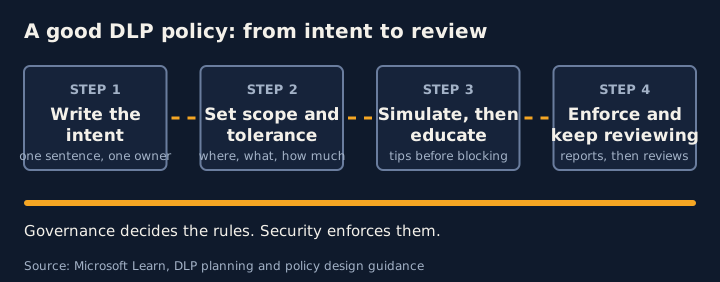
Microsoft says you should be able to summarise the business intent of every policy in a single statement that links the policy to a business purpose. Its design guidance says the statement should answer five questions: what to monitor, how it is scoped, where to monitor, which conditions must be matched and what action to take.
A hypothetical example: “We must stop customer payment card numbers leaving the organisation by email or from our document libraries, unless the finance team has approved the transfer.” That one sentence names the data, the places, the trigger and the action. It also points to a business owner who can say whether the action is acceptable.
It has an agreed leakage tolerance
Microsoft says different groups can hold different views on acceptable leakage, and that zero leakage may cost the business too much. Its example is a security group and a legal team that insist on no sharing of card numbers outside the organisation, while internal auditors must share some with third-party auditors. A policy that blocks all external sharing would disrupt that work and add cost. Microsoft says this needs an internal conversation rather than a technical fix.
That tolerance turns into settings, such as how confident a match must be and how many instances trigger a rule.
It is scoped to where the data and the process live
Microsoft says to find where sensitive items sit and which business processes use them, because that decides which locations the policy should cover. Its example follows a list of card numbers from a secure site, to copies in employees’ own cloud storage, to a laptop, to an email, and applies the policy to all four.
Its actions escalate
Microsoft suggests starting with the least impactful action, audit only, then reviewing the data and tuning before moving to stricter actions. It describes block with override as useful because user feedback helps identify false positives.
It is documented
Microsoft says documented policy designs help with communication, policy reviews, troubleshooting and further tuning. A policy that only one administrator understands is hard to defend or fix.
How to roll it out without breaking the business
Microsoft warns against a new policy unintentionally blocking access to thousands of documents or breaking an existing business process. For policies with a large potential impact, it recommends this sequence:
- Run the policy in simulation without user notifications, and use the reports to assess its impact. Use this stage to test the review and remediation workflow as well.
- Run it in simulation with notifications and policy tips. Users learn the rules, and you can ask them to report false positives. Move on once the results match what the stakeholders intended.
- Enforce it, and keep monitoring the reports and notifications.
Microsoft also says policy tips are a way to train users to avoid risky behaviour, and that regulations, laws and business goals change, so the strategy needs regular reviews.
Questions for your next steering meeting
- Who owns each policy on the business side, not just in IT?
- Can each policy be explained in one sentence?
- What leakage does the business accept, and who agreed it?
- Who reviews matches, how quickly, and what do they do about them?
- When did you last review the policies against changes in regulation and in how the business works?
If the answers are unclear, the problem is usually governance, not the product. To see what your DLP and labelling set-up is doing today, see the Data Protection Health Check.
Frequently asked questions
What should a good DLP policy include?
Microsoft says you should be able to summarise the business intent of every policy in a single statement. A good policy answers what it monitors, how it is scoped, where it applies, which conditions trigger it and what action it takes, and has an owner from the business, not only IT.
Why is a DLP project harder than other security projects?
Because the key decisions are business decisions. Microsoft says IT cannot develop a broad DLP plan on its own without negative consequences, and that the people who know the regulations, the sensitive data and the business processes sit outside IT.
Should a DLP policy aim for zero leakage?
Microsoft says zero leakage may come at too high a cost to the business, and that different groups hold different views on what is acceptable. Agree a leakage tolerance with the business before you set thresholds and actions.
How should we roll out a new DLP policy?
Microsoft recommends running it first in simulation without user notifications, then in simulation with notifications and policy tips, and only then enforcing it, while reviewing reports at each stage.
Sources
- Plan for data loss prevention (DLP) (Microsoft Learn)
- Design a data loss prevention policy (Microsoft Learn)
- Chapter 11: APP 11 Security of personal information (Office of the Australian Information Commissioner)
- The NIST Cybersecurity Framework (CSF) 2.0 (National Institute of Standards and Technology)
General guidance for security and privacy teams. For advice on your legal obligations, speak to a lawyer.